
From Trauma to Tensioned Fascia
This is the detailed version of the injury path: what happens inside the fascia, layer by layer, from trauma to established tension. It is the most technical animation in the path; the patient text summarizes each step. Choose a phase to see it on repeat and read the explanation.
Phase 1 of 8
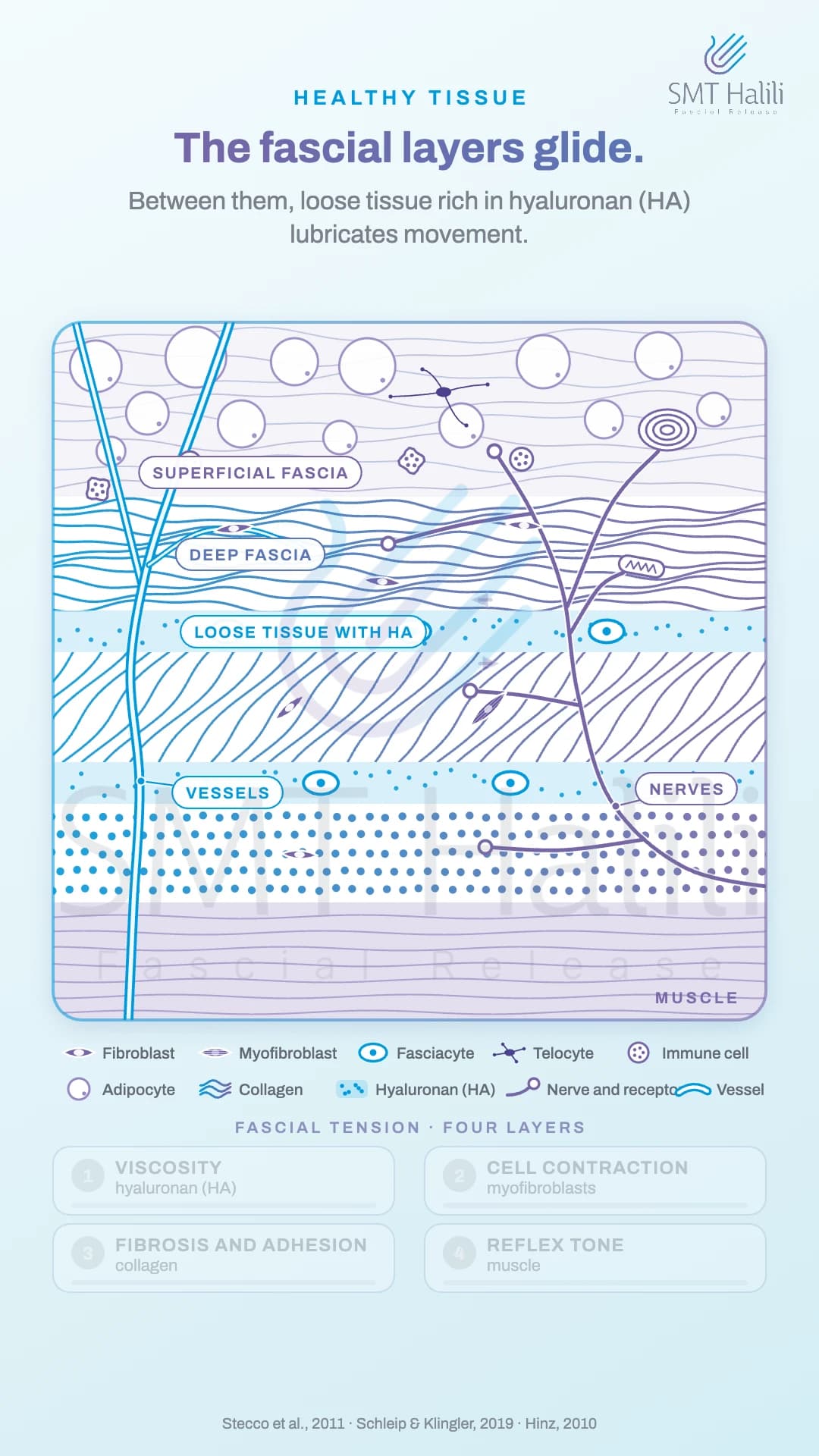
HEALTHY TISSUE
The fascial layers glide.
Between them, loose tissue rich in hyaluronan (HA) lubricates movement.
Learn more
In healthy fascia, the tissue layers glide over one another. Between them is a loose tissue, rich in hyaluronan, that works as a lubricant.
For professionals
Fascial layers (superficial and deep fascia over the muscle) separated by loose connective tissue rich in hyaluronan (HA), which lubricates gliding. The animation shows four layers and the cell legend: fibroblast, myofibroblast, fasciacyte, telocyte, immune cell, and adipocyte.
Phase 2 of 8
1 · INSULT
The trauma tears fibers and capillaries.
Free nerve endings release substance P and CGRP; injured cells release DAMPs.
Learn more
The trauma tears fibers and small vessels. Nerve endings and injured cells release alarm signals.
For professionals
Insult: micro-tears of fibers and capillaries. Free nerve endings release substance P and CGRP; injured cells release DAMPs.
Phase 3 of 8
2 · INFLAMMATION & CONGESTION
Immune cells release cytokines.
Plasma leaks out: edema, lymphatic overload, local hypoxia, and a more acidic pH.
Learn more
Defense cells arrive and release inflammatory substances. Fluid from the blood leaks out: the area swells, drains poorly, receives less oxygen, and becomes more acidic.
For professionals
Inflammation and congestion: mast cells and macrophages release cytokines (IL-1β, IL-6, TNF-α, TGF-β1); plasma leaks out, with edema, lymphatic overload, local hypoxia, and acidic pH.
Phase 4 of 8
3 · GROUND SUBSTANCE
Hyaluronan fragments and aggregates.
Viscosity rises and the layers stop gliding. This is densification.
Learn more
Hyaluronan, the lubricant, fragments and clumps together. The tissue becomes more viscous and the layers stop gliding: this is densification.
For professionals
Ground substance: fragmented and aggregated HA, increased viscosity, and loss of gliding between layers. Densification, still reversible, as the animation marks.
Phase 5 of 8
4 · CELLS
Fibroblasts become myofibroblasts.
Slow, sustained, smooth-muscle-like contraction, with no motor command.
Learn more
Tissue cells, the fibroblasts, turn into myofibroblasts, which can contract. It is a slow, sustained contraction that does not depend on a motor command.
For professionals
Differentiation of fibroblasts into myofibroblasts (α-SMA) under TGF-β1 and mechanical tension: slow, sustained, smooth-muscle-like contraction, with no motor command.
Phase 6 of 8
5 · FIBROUS MATRIX
Collagen creates adhesions.
Disorganized type III, then type I with more cross-links. This is fibrosis.
Learn more
New collagen is laid down in a disorganized way and creates adhesions. Over time, it becomes a stiffer collagen, with more cross-links: this is fibrosis.
For professionals
Fibrous matrix: disorganized type III collagen, then type I collagen with more cross-links. Adhesions and fibrosis.
Phase 7 of 8
6 · NERVES, AGAIN
The receptors become sensitized.
Nociception produces protective muscle tone and sympathetic discharge.
Learn more
The tissue's receptors become sensitized and the pain threshold drops. The nervous system responds with protective muscle tone and more sympathetic activity.
For professionals
Receptor sensitization (lowered threshold). Nociception produces protective muscle tone and sympathetic discharge, which stimulates TGF-β (in the animation: 'sympathetic discharge → TGF-β').
Phase 8 of 8
RESULT
A self-feeding cycle.
The stiff matrix keeps myofibroblasts active, which produce more matrix and more stiffness.
Learn more
A cycle closes: the stiff matrix keeps the contractile cells active, which produce more matrix and more stiffness.
For professionals
Self-sustaining cycle through mechanotransduction: the stiff matrix keeps myofibroblasts active, which generate more matrix and more stiffness. Sources cited in the animation: Stecco et al., 2011; Schleip & Klingler, 2019; Hinz, 2010.