
The Subtle Touch: From Tension to Glide
This animation shows the method's model for the subtle touch: why too much force is read as a threat, what the tissue does with a light, sustained contact, and how long that takes. It is schematic, with no anatomical reference value. Choose a phase to see it on repeat and read the explanation.
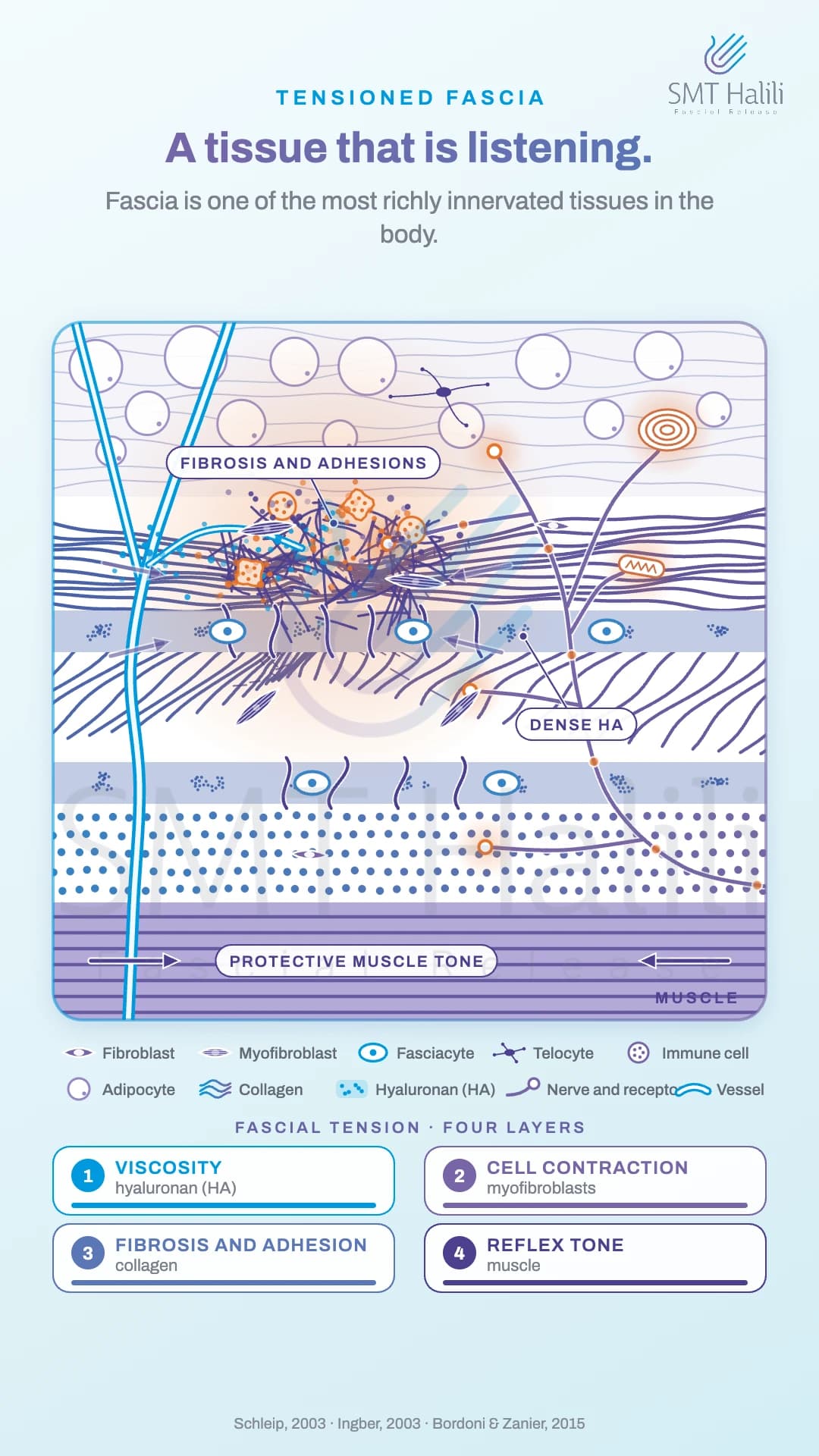
Phase 1 of 10
TENSIONED FASCIA
A tissue that is listening.
Fascia is one of the most richly innervated tissues in the body.
Learn more
Tensioned fascia is a tissue that is listening: it is one of the most richly innervated tissues in the body.
For professionals
Tensioned fascia (fibrosis and adhesions, dense HA, protective muscle tone), richly innervated: a tissue 'that listens'.
Phase 2 of 10
TOO MUCH FORCE
The body reads it as a threat.
Press harder, and it stiffens.
Learn more
If the pressure is too strong, the body reads it as a threat and stiffens even more.
For professionals
Strong pressure read as a threat: reflex stiffening ('threat: the body stiffens').
Phase 3 of 10
THE SUBTLE TOUCH
A light, sustained contact.
Often no more than the weight of a coin.
Learn more
The subtle touch is a light, sustained contact. Often no more than the weight of a coin.
For professionals
Light, sustained touch, on the order of the weight of a coin.
Phase 4 of 10
LISTENING
The receptors receive the signal.
A touch the nervous system can receive and respond to.
Learn more
The tissue's receptors receive that signal. It is a touch the nervous system can receive and respond to.
For professionals
Mechanoreceptors (in the animation: Pacini and Ruffini) receive the stimulus and transmit it to the central nervous system.
Phase 5 of 10
RESPONSE
The nervous system stops protecting.
Reflex muscle tone releases and sympathetic activity decreases.
Learn more
The nervous system stops protecting: reflex muscle tone releases and sympathetic activity decreases.
For professionals
Response: reduction of reflex muscle tone (protective tone releases) and of sympathetic activity.
Phase 6 of 10
MECHANOTRANSDUCTION
The cells can hear.
Gentle pressure becomes a biological response: cell contraction lets go.
Learn more
The cells also 'hear' the gentle pressure and respond: cell contraction lets go.
For professionals
Mechanotransduction: gentle pressure becomes a biological response; myofibroblasts relax.
Phase 7 of 10
GROUND SUBSTANCE
Hyaluronan lubricates again.
Congestion drains, viscosity drops, and the layers glide again.
Learn more
Hyaluronan lubricates again: congestion drains, viscosity drops, and the layers glide again.
For professionals
Ground substance: drainage of congestion, drop in HA viscosity, and return of gliding between the layers.
Phase 8 of 10
FIBROUS MATRIX
The matrix reorganizes.
With time and movement, collagen realigns and adhesions release.
Learn more
The matrix reorganizes. With time and movement, collagen realigns and adhesions release.
For professionals
Remodeling of the fibrous matrix: collagen realignment and release of adhesions, with time and movement.
Phase 9 of 10
THE TISSUE'S TIME
Weeks, months, even years.
The time fascia takes to reorganize varies with the chronicity of the inflammation.
Learn more
This takes time: weeks, months, even years. The time fascia takes to reorganize varies with the chronicity of the inflammation.
For professionals
Variable tissue reorganization time, from weeks to years, according to the chronicity of the inflammation.
Phase 10 of 10
THE SUBTLE TOUCH
Gentle because it is precise.
The method is not gentle because it is weak. Here, gentle is the mechanism.
Learn more
The method is not gentle because it is weak. Here, gentle is the mechanism: gentle because it is precise.
For professionals
The subtle touch as mechanism, not as lack of intensity. Sources cited in the animation: Schleip, 2003; Ingber, 2003; Bordoni & Zanier, 2015.