
Temporal Model of Central Sensitization
The Temporal Model of Central Sensitization (TMCS) is a hypothesis by Dr. Adi Halili, still under investigation, about how central sensitization sets in and is maintained. Choose a phase to see it on repeat and read the explanation.
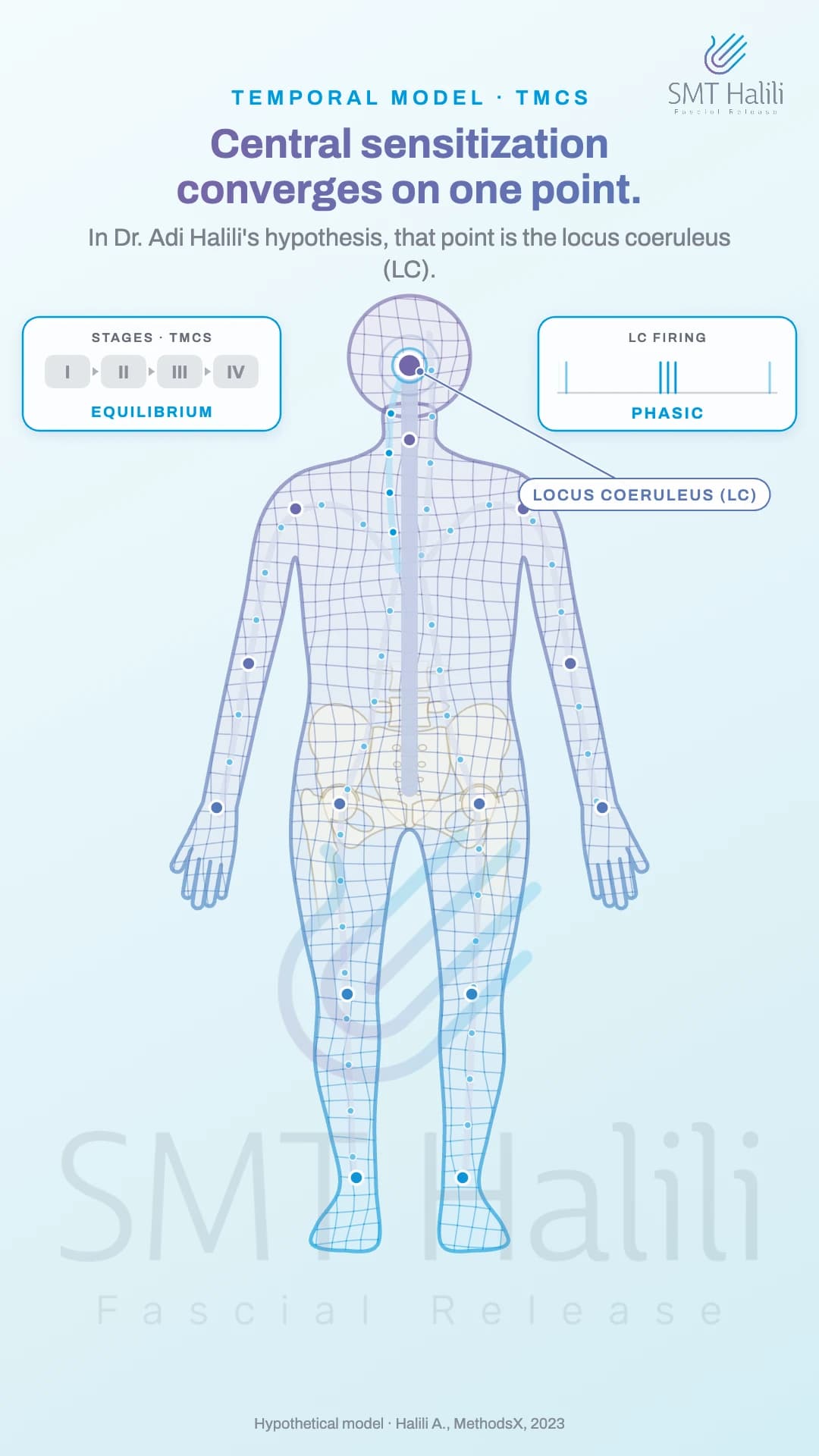
Phase 1 of 13
TEMPORAL MODEL · TMCS
Central sensitization converges on one point.
In Dr. Adi Halili's hypothesis, that point is the locus coeruleus (LC).
Learn more
This model is a hypothesis by Dr. Adi Halili. It proposes that the different pathways of central sensitization converge on a single point in the nervous system: the locus coeruleus, or LC.
For professionals
Hypothesis: the locus coeruleus (LC) as the point of convergence of central sensitization. Panels in the animation: stages I–IV of the model and the LC firing mode (phasic).
Phase 2 of 13
STAGE I · REST
The LC works in phasic mode.
It responds to each stimulus and returns to baseline. This is normal functioning.
Learn more
In stage I, the LC works in phasic mode: it reacts to each stimulus and soon returns to rest. This is normal, everyday functioning.
For professionals
Stage I of the five-stage model (Halili, 2023, Table 1): phasic activation of the LC-noradrenaline system. Resting state, with no salient stimuli, tonic activation, aberrant afferent input, or oxidative stress. Normal functional state.
Phase 3 of 13
STAGE II · SALIENT STIMULUS
Something draws attention.
The LC enters a targeted tonic mode to focus on the stimulus. Still normal.
Learn more
In stage II, something draws the body's attention. The LC switches to tonic mode, but in a targeted way, only to focus on that stimulus. Then it returns to normal. This is still healthy functioning.
For professionals
Stage II: salient stimuli. Targeted tonic activation, allowing focus on sensory information or efferent activity. Normal functional state.
Phase 4 of 13
STAGE III · THREAT
The stimulus is coded as a threat.
Tonic activation spreads across the body. Still normal, but if it is prolonged, it opens the way to stage IV.
Learn more
In stage III, the stimulus is interpreted as a threat, and the activation spreads across the body, preparing it to respond. This is still normal. According to the model, the problem begins when this state is prolonged: it is the gateway to stage IV.
For professionals
Stage III: threat coding of the salient stimulus. Wide-ranging tonic activation of efferent and afferent pathways, to keep the focus and respond to the stimulus. Normal functional state. Stage IV is entered after a prolonged and sustained period in stage III.
Phase 5 of 13
FROM III TO IV · CONGESTION
Drainage becomes impaired.
Venous and lymphatic stasis and fascial restriction reduce drainage and perfusion, including of the central nervous system.
Learn more
The path from stage III to IV begins with congestion: blood and lymph return with more difficulty and the fascia becomes more restricted. As a result, tissues drain less and receive less circulation, including the central nervous system.
For professionals
Venous and lymphatic stasis and fascial restriction, with reduced drainage and perfusion, including of the central nervous system (CNS).
Phase 6 of 13
FROM III TO IV · INFLAMMATION
Congested tissue sustains inflammation.
Low grade. And aberrant visceral afferent input keeps the nervous system bombarded.
Learn more
According to the model, congested tissue sustains a low-grade inflammation that persists. At the same time, abnormal signals from the internal organs keep reaching the nervous system, which stays under constant bombardment.
For professionals
Chronic low-grade inflammation sustained by congested tissue. Aberrant visceral afferent input keeping the nervous system under continuous stimulation.
Phase 7 of 13
FROM III TO IV · OXIDATION
Less perfusion, more inflammation: oxidative load.
The LC is particularly vulnerable: high metabolic demand, noradrenergic neurons.
Learn more
With less circulation and more inflammation, the model proposes an increase in oxidative load. The LC would be especially vulnerable to it, because it has a high energy demand.
For professionals
Lower perfusion and greater inflammation result in oxidative load. Particular vulnerability of the LC: high metabolic demand and noradrenergic neurons. In the animation: less oxygenated flow to the LC.
Phase 8 of 13
FROM III TO IV · TONIC LC
Tonic mode becomes sustained.
From responsive, with a return to baseline, to elevated and sustained discharge: the sensitized state.
Learn more
In the earlier stages, tonic mode was temporary: the LC returned to rest. In the model, it starts firing at an elevated, continuous rate. This is what the animation calls the sensitized state.
For professionals
Tonic firing no longer returns to baseline and becomes sustained (elevated, continuous discharge). In the animation panel, the sensitized state appears as hypervigilance, lowered pain threshold, dysautonomia, poor sleep, and anxiety.
Phase 9 of 13
STAGE IV
Closed loops that reinforce themselves.
The condition no longer depends on the original trigger. That is why treating only the site of pain fails.
Learn more
In stage IV of the model, the steps begin to feed one another in closed loops, and the condition no longer depends on what started it. According to the model, that is why treating only the site of pain fails.
For professionals
Stage IV: central sensitization, an abnormal functional state. Self-reinforcing loop: tonic LC → dysautonomia + congestion → inflammation + oxidation → tonic LC. The condition becomes independent of the original trigger. The model also describes a stage V (neural degeneration, in susceptible individuals), outside the focus of treatment and not shown in the animation.
Phase 10 of 13
THREE KEYS · 1
Reduce aberrant visceral afferent input.
Less bombardment of the nervous system.
Learn more
The model proposes three keys for treatment. The first is to reduce abnormal signals coming from the internal organs, to lessen the bombardment of the nervous system.
For professionals
Key 1: reduce aberrant visceral afferent input. SMT protocols indicated in the animation: LAUG (Lower-Abdominal-Urogenital), Barral (Barral Abdominal Motility), and GUOU (Genito-Urinary-Ovarian-Uterus).
Phase 11 of 13
THREE KEYS · 2
Shift inflammatory activity.
Away from the brain.
Learn more
The second key is to shift inflammatory activity away from the brain.
For professionals
Key 2: shift inflammatory activity away from the brain. SMT protocols indicated in the animation: UD (Urinary-Drainage) and DCS (Diaphragm-Cranial-Sinus).
Phase 12 of 13
THREE KEYS · 3
Restore oxygenated flow to the LC.
Reducing oxidative stress.
Learn more
The third key is to restore the supply of oxygenated blood to the LC, reducing oxidative stress.
For professionals
Key 3: restore oxygenated flow to the LC, reducing oxidative stress. SMT protocol indicated in the animation: CCCV (Cardiac-Cervical-Cranial-Vascular).
Phase 13 of 13
THE SEQUENCE OF THE METHOD
First, desensitize.
Decongestion before regional and structural work, with 10 to 21 days between sessions.
Learn more
That is why the method begins with desensitization: decongestion first, then regional and structural work. Sessions are spaced, with 10 to 21 days between them.
For professionals
Sequence: desensitization and decongestion before regional and structural work, with an interval of 10 to 21 days between sessions.