
Trauma, Central Nervous System, and Tension
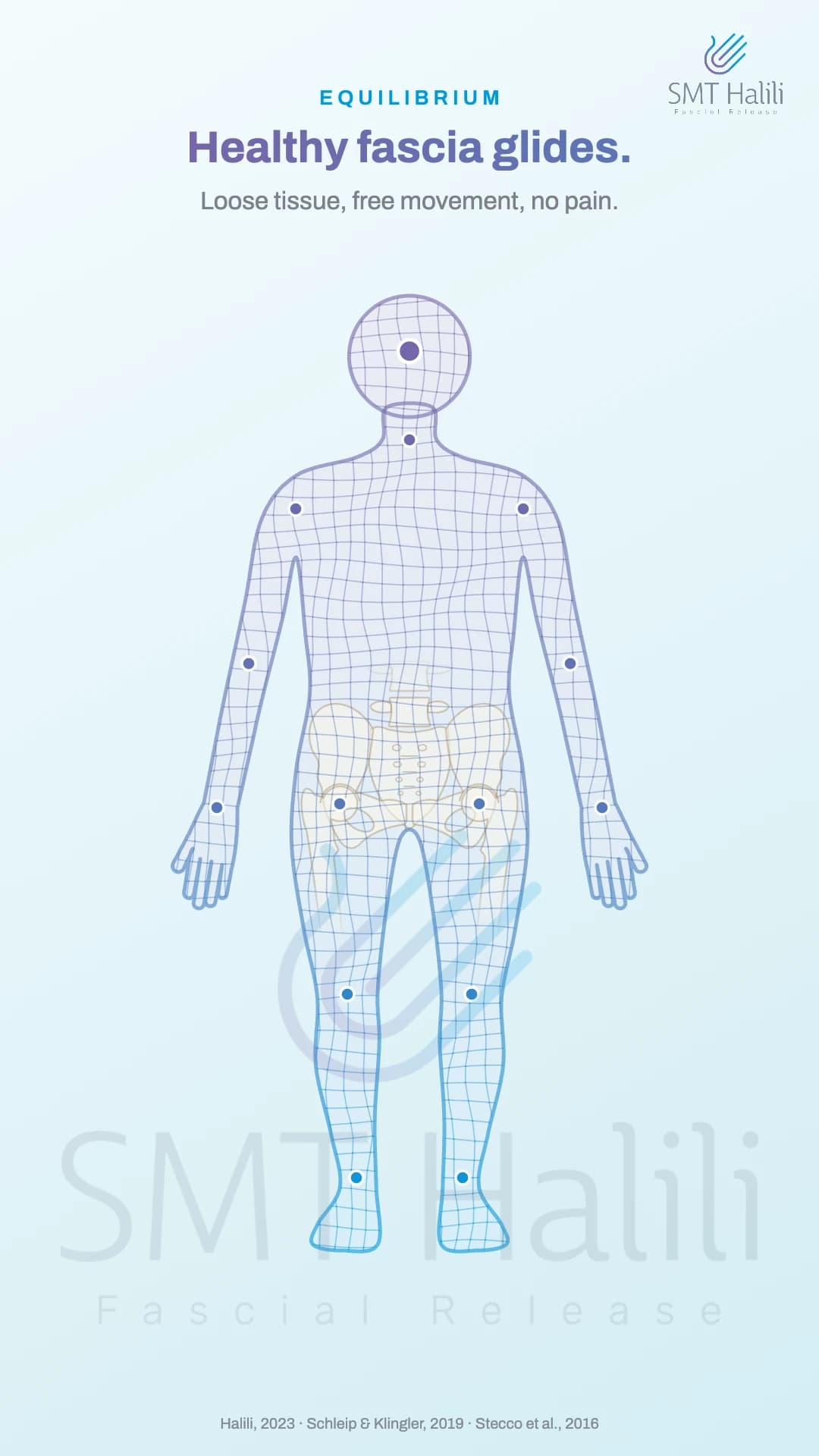
After a trauma, it is the central nervous system that tenses the fascia. This animation shows the round trip between tissue and nervous system. Choose a phase to see it on repeat and read the explanation.
Phase 1 of 6
EQUILIBRIUM
Healthy fascia glides.
Loose tissue, free movement, no pain.
Learn more
With healthy fascia, the tissue is loose, movement is free, and there is no pain.
For professionals
Healthy fascia: loose tissue, free movement, no pain. The animation's reference state.
Phase 2 of 6
TRAUMA
A trauma hits the tissue.
A sprain, a fall, an overload.
Learn more
A trauma hits the tissue: a sprain, a fall, or an overload.
For professionals
Mechanical insult to the fascial tissue: sprain, fall, or overload.
Phase 3 of 6
AFFERENT SIGNAL
The warning travels up to the central nervous system.
Fascial receptors send the information up.
Learn more
The fascia's receptors notice what happened and send a warning to the central nervous system.
For professionals
Afferent signal: fascial receptors carry information about the trauma to the central nervous system.
Phase 4 of 6
EFFERENT RESPONSE
The central nervous system responds.
Down comes the order for the tissue to protect itself.
Learn more
The central nervous system responds: down comes the order for the tissue to protect itself.
For professionals
Efferent response: the protective command descends from the central nervous system to the tissue.
Phase 5 of 6
TENSION
The fascia contracts.
The tissue becomes tense, stiff, and sensitive.
Learn more
The fascia contracts. The tissue becomes tense, stiff, and sensitive.
For professionals
Fascial contraction: tense, stiff tissue with increased sensitivity.
Phase 6 of 6
THE ORIGIN OF TENSION
It is the central nervous system that tenses the fascia.
That is why SMT treats the tissue and the nervous system.
Learn more
It is the central nervous system that tenses the fascia. That is why SMT treats the tissue and the nervous system as well.
For professionals
Fascial tension is maintained by the nervous system (afferent–efferent loop); SMT treats the tissue and the nervous system. Sources cited in the animation: Halili, 2023; Schleip & Klingler, 2019; Stecco et al., 2016.